Marketing AI · Built in Production

AI systems built to move the number.

I've built 20+ AI tools for marketing teams. Products that ship, pipelines that run in production, automation that holds up under real client load. Every project in this file was built to move a specific number, not to demo well in a deck.

§ 01: Evidence

By the numbers

20+
OutputAI products built

Custom tools and automations built for clients and internal teams, all in active production, not sitting in a sandbox.

19% 70%
OutcomeRenewal rate

Climbed from 19% after deploying AI-powered client engagement reports across 80+ accounts at Lean Marketing.

15+
ReclaimedWeekly hours saved

Recurring automations that quietly delete manual, repetitive work for the team, running every week without babysitting.

§ 02: The Approach

Small teams should not have to move slow. The hours a good marketer spends on predictable work are hours that compound into nothing, while the irreplaceable work waits. That gap is what I build AI to close.

P.01

Real products, in production

Every tool I build is live, in use, and load-bearing for the team that runs it. The bar for shipping is whether the team would feel its absence if it disappeared tomorrow, a higher bar than "it worked in testing," and the only one that produces durable systems.

P.02

Automate the predictable, leave the exception to the human

If a marketer does the same task the same way every time, that task is a candidate for automation. The human's role in a well-designed system is the edge cases, the judgment calls, and the work that actually requires their pattern recognition. Anything below that line shouldn't be on their plate.

P.03

Measure what actually changes

An AI system that doesn't move a number isn't working, no matter how impressive the output looks. Every project here was built against a specific outcome and measured against whether it produced the change. Without that discipline, AI work becomes a portfolio of demos instead of a portfolio of results.

§ 03: The Work

Four case
studies.

Four areas where I've shipped AI systems that produced measurable change inside real businesses. Each one starts with a problem worth solving and ends with a number that moved.

CH. 01: Product Creation STACK: CLAUDE / N8N / OPENAI / WEBFLOW / HUBSPOT
01

AI products that ship and get used

Most AI work gets stuck in prototype mode: the difference between an interesting experiment and a tool people open every day. The work in this file went into production and stayed there.

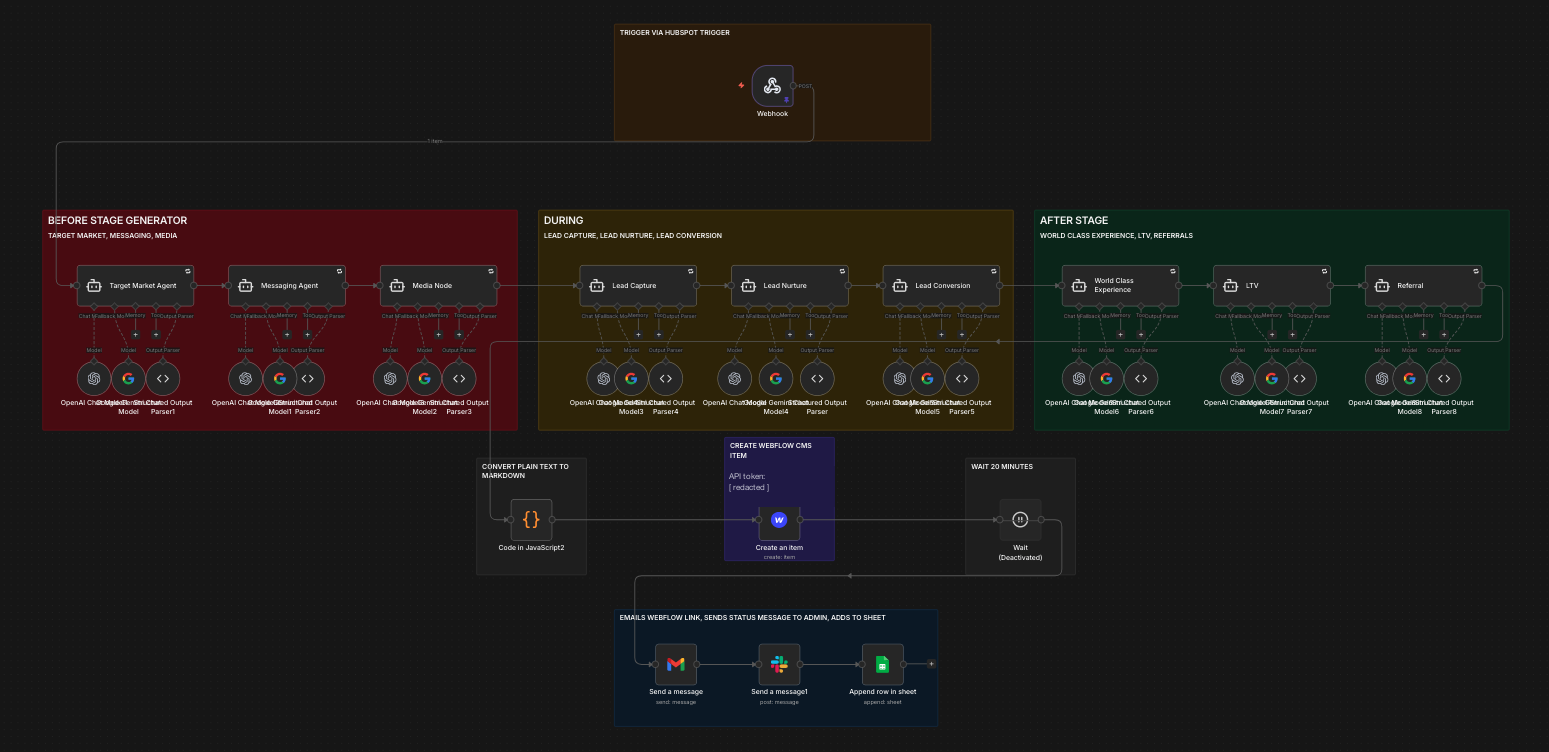
This portfolio site was built with Claude Code as a development partner, end to end. The 1PMP Architect is a multi-step AI agent that generates a complete marketing plan from raw client inputs in under 15 minutes, used by 100+ founders inside the Lean Marketing Accelerator to produce strategy documents that previously took days. Lean Intelligence is an internal analytics dashboard that gives advisors a live view across 80+ client accounts without digging through five separate tools, eliminating the manual report-pull that used to eat hours a week.

EXHIBIT A: live automation workflow FIG. 01
AI automation workflow built in production
100+
Active usersFounders running the 1PMP Architect to generate full marketing plans that used to take days.
CH. 02: Data Analysis STACK: CLAUDE / HUBSPOT / N8N / TRANSCRIPT ANALYSIS
02

Turning client data into renewal revenue

At Lean Marketing, clients were coming up for renewal without a clear way to see the value they'd built. Advisors went into those conversations on instinct, which produces exactly the renewal rate you'd expect when nobody has the receipts in front of them.

I built an AI system that pulled every piece of engagement data per client: coaching call transcripts, health scores, milestone wins, support interactions, session attendance, sentiment signals, and synthesized it into a single report per account. Internally we called it holding up the mirror, because it showed clients what they'd actually built over the engagement, in evidence rather than narrative. Advisors walked into renewals with the data instead of the pitch, and the numbers followed.

EXHIBIT B: renewal rate, before vs. after FIG. 02
Before 19%
After 70%
19% 70%
Renewal rateAfter deploying AI-powered engagement reports for 80+ clients at Lean Marketing.
CH. 03: Content Creation STACK: CLAUDE / WHISPER / N8N / CUSTOM GPTS
03

Calls in, content out

The best marketing content for a business is usually buried inside it, sitting in client conversations, advisor insights, and the stories that never get written down. Most teams know this and still can't operationalize it, because the path from "we said something useful on a call" to "we have a finished post" takes hours of manual lift nobody has.

I built a content pipeline at Lean Marketing that starts with coaching call recordings and ends with finished drafts. Recordings get transcribed, run through a prompt pipeline that extracts insights, client wins, and teachable moments, then routed into LinkedIn posts, email sequences, and blog drafts. The voice is a trained model built from real content examples, not a template, so the output sounds like the company, instead of like every other AI content stack on the market.

EXHIBIT C: the content pipeline FIG. 03
Coaching call Transcribe Extract insights Draft in trained voice Published ✓
< 20 min
TurnaroundA 60-minute coaching call becomes 3–5 finished content pieces, grounded in real conversation, not a blank page.
CH. 04: Automation STACK: N8N / HUBSPOT / NOTION / MAKE / SLACK / ZAPIER
04

One source of truth for the whole team

Most marketing teams have their data spread across five tools with nothing keeping any of it in sync. Advisors chase updates, managers build manual reports, and nobody works from the same picture, meaning every decision is being made on data that's some flavor of stale.

At Lean Marketing, I built a set of automations that created a single source of truth the whole team could trust. New client onboards, coaching notes, milestone hits, and health score changes flow into the right places automatically. The system handles the routing, the humans handle the advising. The team stopped chasing spreadsheets and started spending their time on the work that actually moves accounts.

EXHIBIT D: before and after FIG. 04
Before
  • Data split across 5 separate tools
  • Weekly reports built by hand
  • Advisors chasing status updates
  • 15+ hours lost every week
After
  • One view, always current
  • Updates flow automatically
  • 80+ accounts in real time
  • Zero manual data work
15+ hrs
Reclaimed weeklyPer week, recurring, with no manual intervention required to keep it running.
§ 04: Next

Let's build AI into your workflow.

Tell me where your team is losing the most time. There's almost always a number waiting to be moved.

Get In Touch